
In a statement on Sunday, the Maldivian foreign ministry said they were aware of the "derogatory remarks on social media platforms against foreign leaders and high-ranking individuals".
External Affairs Minister S Jaishankar reiterated India's stance on the Depsang and Demchok areas in Ladakh, stating that Indian security forces will patrol up to the historical limits. He also firmly rejected Nepal's alleged territorial claims, asserting that India's position on the border is clear and will not be altered. Jaishankar also addressed the situation in Myanmar and India's 'Neighborhood First' policy, highlighting the government's commitment to regional cooperation and development.
'By his words, actions, and body language during their joint press appearance wanted to convey his personal respect and, more broadly, his desire to work closely with India.'
Delhi's appeasement strategy may now translate as more mega arms deals with the US, generating substantial business and job creation in the American economy. Make no mistake, Americans will use it to pressure India, predicts Ambassador M K Bhadrakumar.

The Congress on Sunday said it was not stopping anyone from being part of diplomatic delegations to be sent to various countries following Operation Sindoor and that its leaders who have been named at the instance of the government must listen to their conscience and contribute to the exercise.

Shah also said that India has now joined the league of countries like the United States and Israel in carrying out surgical strikes.
'Trump has no more elections to fight and his soaring ambition, which is no secret, will be to carve out a presidential legacy that outshines by far all his mediocre predecessors.' 'Trump's turnaround on the H-1B visa debate shows that he can take tough decisions and there are no holy cows in his domain,' asserts Ambassador M K Bhadrakumar.
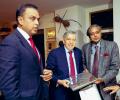
All-party parliamentary delegations on Friday met leaders and diplomats from several countries to galvanise international action against terrorists and decisively counter the tactics of those who perpetrate, support and sponsor cross-border terror activities against India.

By threatening to punish India with high tariff, Trump is actually planting a tantalising thought in the Indian mind that the Modi government should suitably 'incentivise' him, explains Ambassador M K Bhadrakumar.
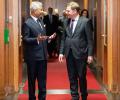
External Affairs Minister S Jaishankar has asserted that India has zero tolerance for terrorism and will never give in to nuclear blackmail, emphasizing that New Delhi will deal with Pakistan purely bilaterally. He made these remarks during a joint press conference with his German counterpart in Berlin, where he also highlighted the importance of the strategic partnership between India and Germany, emphasizing the need for a free trade agreement between the two nations.

'However, we must implement a tit-for-tat approach -- reciprocating their conduct with precision.' 'If they demonstrate respect, we respond accordingly. If they adopt hostile positions, we mirror that hostility with equal intensity.'

Describing India as an important member of the Quadrilateral Security Dialogue (the Quad) and a crucial partner for stability in the Indo-Pacific, the letter said that the lawmakers support the deepening strategic partnership between the two countries.
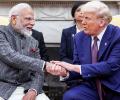
India has firmly rejected any involvement of a third party in its border dispute with China, declining an offer of mediation from US President Donald Trump. Foreign Secretary Vikram Misri emphasized India's commitment to resolving bilateral issues through direct dialogue, stating that New Delhi has always maintained a bilateral approach in dealing with such matters. This stance underscores India's position that the border dispute with China should be addressed through direct negotiations between the two countries.

Nepalese Prime Minister Pushpa Kamal Dahal 'Prachanda', Bhutanese Prime Minister Tshering Tobgay and Prime Minister of Mauritius Pravind Jugnauth are set to be invited to Modi's swearing-in ceremony.

Gujarat Chief Minister Narendra Modi is "ideologically hawkish, but economically opportunistic", a noted American scholar writes in a new book.
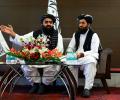
'During the 5-day visit, Amir Khan Muttaqi would have, conceivably, bumped into our powerful security agencies one way or another and some interaction would have ensued, which, in turn, can lead to future dealings.' 'Indeed, this will be the one crucial template of the Indo-Afghan relationship that Pakistan will be monitoring closely,' points Ambassador M K Bhadrakumar.

The fundamental construct of India's neighbourhood policy still needs to be what Vajpayee postulated, Manmohan Singh embraced, and Modi energised. It's just that we need to junk domestic politics and excessive religiosity, while acquiring much humility and a renewed respectfulness towards our neighbours, recommends Shekhar Gupta.

'For the Indian economy to maintain a growth rate of 7 to 8 per cent, it needs large foreign direct investment coming in, and that's mainly coming from the US.'

PM Narendra Modi's proposed visit to Israel is "worrisome" as it undermines India's position on Palestine, senior Congress leader Anand Sharma said on Wednesday.

Prime Minister Narendra Modi will deliver on Tuesday his 10th consecutive Independence Day address which will also be his last before the 2024 Lok Sabha elections, as a mood of anticipation builds around the annual showpiece event that he has used to present his government's report card, unveil flagship schemes and lay down his vision for the country.
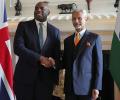
India's External Affairs Minister S Jaishankar has stated that the US administration under President Donald Trump is moving towards multipolarity, which aligns with India's interests. He also revealed that India and the US have reached an agreement on the need for a bilateral trade pact. Jaishankar touched upon various foreign policy issues including India's role in the Russia-Ukraine conflict, the trajectory of the BRICS grouping, and relations with China during a session at the Chatham House think-tank in London.
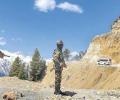
One hopes the new Lok Sabha will mark a break from a dismal tradition -- lack of interest in defence and security policies, argues Colonel Anil A Athale.

Being a pragmatist Modi is not likely to give preference to China over Japan. Both security and economic aspects are likely to shape Modi's decision in terms of engaging the two biggest economies of Asia, says Sana Hashmi.
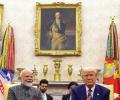
'Modi's intention was to create goodwill that will allow India to be seen by Trump as more than just a bad tariff problem.' 'He succeeded brilliantly on that count but none of these wins are unfortunately permanent.' 'Modi will have to do this again and again if Trump's grievances are to be durably assuaged.'
Making Bhutan his first foreign destination, Prime Minister Narendra Modi on Sunday vowed to nurture bilateral relations which he described as 'B2B - Bharat to Bhutan'.

'America holds about 16% of IMF voting rights, giving it crucial influence over Pakistan's desperately needed bailout loans.'
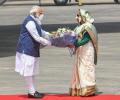
Prime Minister Narendra Modi arrived in Dhaka on Friday on a two-day visit to Bangladesh during which he will attend the celebrations of the golden jubilee of the country's independence, the birth centenary of 'Bangabandhu' Sheikh Mujibur Rahman and hold talks with his counterpart Sheikh Hasina.
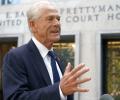
Former White House trade advisor Peter Navarro has criticised India for continuing to procure Russian oil, alleging profiteering and contributing to the Russia-Ukraine war. India defends its energy procurement as driven by national interest and market dynamics.

GST 2.0 may cushion consumers against US tariffs, but like the 2019 corporate tax cut, it risks being another tactical fix rather than a structural growth strategy, expects Debashis Basu.
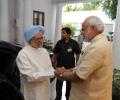
former Prime Minister Manmohan Singh on Wednesday met Prime Minister Narendra Modi and the two discussed issues related to the economy and foreign policy.
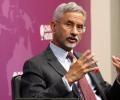
"From President Trump's perspective, the one big shared enterprise that we have is the Quad, which is an understanding where everybody pays their fair share. There are no free riders involved. So that's a good model which works," he said. The Quad alliance consists of the US, India, Australia and Japan.
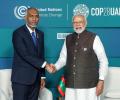
Describing the comments as "uncalled for", he said that the ruling party has these "extreme elements" who are calling for India out.
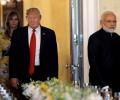
'China was the elephant in the Oval Office and Trump would have sensed that Modi's foreign policy architecture has become disoriented sans the US' pivot to Asia,' points out Ambassador M K Bhadrakumar.

Prime Minister Narendra Modi's Nepal visit was an eye-opener for most Indians, as it appears as though the hard feelings of 17 years of neglect by Indian PMs has been overcome by this single, sincere visit, says Rajeev Srinivasan.

'If you look at the relationship with Pakistan, or the relationship with China, both are today, more uncertain than they were when this government came into power.'

'The background for the Saudi-Pakistan agreement is the fact that the regional security order has collapsed due to the Israeli attack on Doha.' 'The Americans have largely abandoned their security guarantee for West Asia and the region has no choice but to look at alternatives.'

An independent United States Congressional research report has alleged that the scope and scale of human rights abuses in India has increased under the leadership of Prime Minister Narendra Modi.
World leaders, including US President Donald Trump, Russian President Vladimir Putin and Israeli Prime Minister Benjamin Netanyahu, condemned the terror attack in Jammu and Kashmir that killed 26 people, expressing solidarity with India. The attack was claimed by The Resistance Front (TRF), a proxy of the Pakistan-based Lashkar-e-Taiba (LeT) terrorist group. The attack came during US Vice President J D Vance's maiden visit to India. Prime Minister Modi, who had arrived in Saudi Arabia on a two-day visit earlier in the day, cut short his visit and departed for New Delhi on Tuesday night following the attack.

A deadly terror attack targeting tourists in Jammu and Kashmir's Pahalgam on Tuesday drew strong condemnation and outrage. 26 people, including two foreigners and two locals, were killed in the attack, which is the deadliest in the Valley since the Pulwama strike in 2019. Prime Minister Narendra Modi asserted that the perpetrators will not be spared and their evil agenda will never succeed. Opposition leaders demanded accountability, claiming the government's claims of normalcy in Kashmir have fallen flat.

Modi began his nearly 45-minute speech by welcoming the people who attended the rally in the Kashmiri language. "This time, the (assembly) election will decide the future of Jammu and Kashmir, which has remained the target of foreign powers since Independence," he told the gathering.
